

Intelligent Lead Qualification & CRM Routing Automation - Case Study //.003
The Challenge
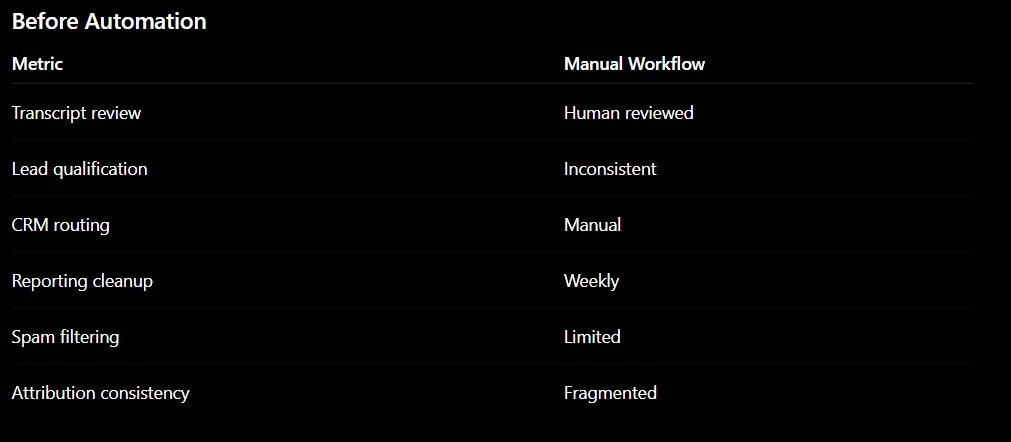
A multi-location home services company was generating hundreds of inbound phone leads each month through paid search, local SEO, and directory traffic. While lead volume was strong, operational inefficiencies inside the intake process were creating major reporting blind spots and sales delays.
The client faced four core problems:
No reliable way to determine whether inbound calls were valid leads or spam/misdials
Manual review of call recordings and transcripts consuming hours every week
Inconsistent source attribution across marketing channels
Delayed or incorrect CRM routing to regional sales teams
The result was fragmented reporting, slower response times, and wasted labor across marketing and operations teams.
The Objective
Build an automated system capable of:
Pulling inbound call data from WhatConverts
Analyzing transcripts using AI-driven logic
Determining whether a lead was valid or invalid
Applying standardized source tagging
Routing qualified leads into the correct HubSpot pipeline automatically
Preventing CRM contamination from spam or low-intent calls
Workflow Architecture
1. Inbound Call Capture
Every inbound phone lead was captured through WhatConverts, including:
Call recording
Transcript
Tracking number
UTM/source attribution
Call duration
Timestamp
Caller phone number
2. AI Transcript Analysis
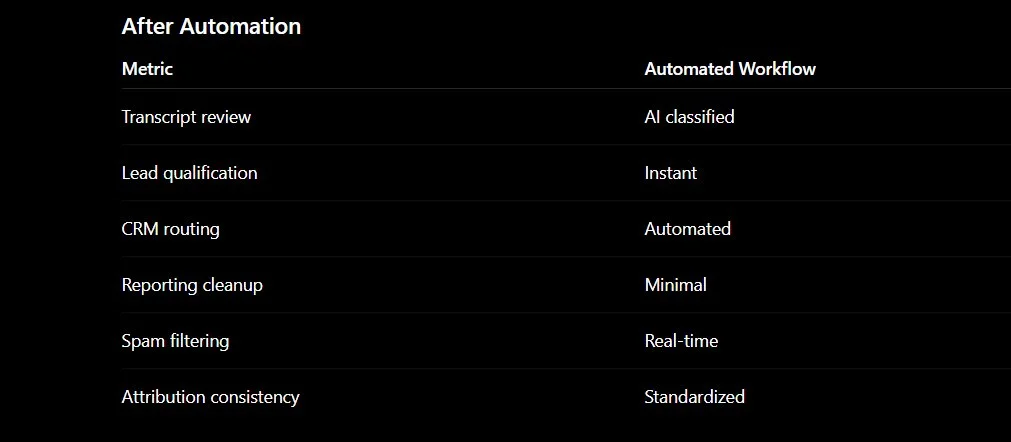
The transcript was automatically analyzed using GPT-based classification logic to determine:
Was this a real sales opportunity?
Was the caller requesting service?
Was the call spam, recruiting, solicitation, or support-related?
Was the lead geographically relevant?
Did the caller show purchase intent?
Each call received:
Valid Lead: YES / NO
Intent categorization
Confidence scoring
Service-type tagging
3. Source & Campaign Tagging
The system normalized attribution data across channels:
Google Ads
Organic Search
Local Service Ads
Yelp
Direct Traffic
Referral Campaigns
This created consistent CRM reporting across all locations and eliminated manual source cleanup.
4. Intelligent CRM Routing
Qualified leads were automatically routed inside HubSpot based on:
Geographic region
Service line
Branch ownership
Existing contact ownership
Lead type
Invalid calls were suppressed from primary reporting dashboards while still archived for QA visibility.
Example Outcomes
Estimated Impact
Operational Savings
~175 Hours Saved Per Year
The automation eliminated repetitive manual tasks including:
Reviewing and categorizing calls
Cleaning CRM source data
Reassigning leads
Filtering spam submissions
Verifying attribution
Updating reporting dashboards
This allowed marketing and operations teams to focus on revenue-generating activities instead of administrative cleanup.
Additional Business Benefits
Faster Sales Response
Qualified leads reached the correct rep immediately.
Cleaner Reporting
Marketing attribution became substantially more reliable across channels and regions.
Reduced CRM Noise
Invalid calls no longer polluted conversion reporting.
Better Marketing Decisions
Teams could optimize spend using cleaner source-level data.
Scalable Infrastructure
The workflow supported multi-location routing logic without additional headcount.
Key Takeaway
Most organizations are already collecting valuable inbound lead data — but very few operationalize it intelligently.
By combining call tracking, transcript analysis, AI qualification, and CRM automation, the client transformed inbound lead handling from a manual operational burden into a scalable intelligence system.
The result was cleaner reporting, faster routing, reduced administrative overhead, and measurable time savings across the organization.